Within the past few weeks Aidan has introduced a couple of imaginary friends, two ghosts in fact, both named Orange Juice. I have not had any experience with imaginary friends in my working background, my siblings never had one, nor do I recall having one as a child, though I have always been fascinated with the topic.
He just brought them up in conversation one day while wondering how something happened, "Oh my friend ghosts must have moved it!" Between my husband and I, he's mentioned them enough times that we realized Orange Juice the ghosts may be hanging around for a while. Lately, if he can't find something he says it was them. I asked him the other day why I can't see them, "They are camouflaged." I haven't seen him "play" with these friends, he just talks about them and I listen.
I read an article a while back that I recall mentioning that some children create imaginary friends around times of a significant change in their life, such as the arrival of a baby, which we happen to be on the verge of. I don't know how significant this pair of friends will become, so I'd like to learn more about this type of make-believe play. I know I have the Internet at my disposal, but I'd like to know if any one has a good book or other resource they'd personally recommend on the topic?
We have a large sliding glass door at our house that leads to our back patio. It's a wonderful view of the pool and the wooded conservation lot in our backyard, except for all the finger smudges from some little boy, and nose prints from the squirrel spying dog! I try to keep its cleanliness under control without driving myself crazy when I saw the potential it had that I'd been missing, what a great blank canvas!
We used washable tempera paint, mixing our primary colors to make additional hues of orange and purple. I showed Aidan how we could also make the colors lighter by adding white paint. For obvious reasons this time of year, we painted eggs on our window. I randomly painted ovals across the whole door and Aidan began decorating the "eggs," filling them in with color, then adding stripes and polka dots.
Patterns emerged and fine motor skills were honed as he painted for 40 minutes with different sized brushes. The feel of the paint brush against the glass almost had a calming effect because I couldn't resist adding the Easter bunny and some grass that Aidan helped me fill in. I have a feeling we'll be using this surface more often! Do you have an underutilized space that could be filled with a child's imagination?
Stay up to date on all our Little Moments and more; like our facebook page, or join us on Google+!
Aidan loves experiments. He makes them up a couple of times a week. Sometimes, it's just a bucket of water in the yard, with a concoction of leaves, dirt, and grass he's collected, that he says will catch bugs or lizards. He's also taken leftover dough from a baking project, stuff it into an empty cardboard tube, close the ends with tape, sprinkle it with flour and water, then ask to spray my husbands expensive "camouflage" on it, so that he could take it into the laundry room to see if it would glow in the dark! It took me a few minutes to figure out what camouflage was when I realized he'd forgotten the name cologne!
We checked out a book from our local library with simple preschool science exploration ideas in it, which is where we found our experiment! A boy who loves to eat a handful of marshmallows for dessert, and has known since the age of eighteen months that camping will lead to roasting marshmallows over the fire, did not hesitate to take this project on! The marshmallow experiment was extremely simple and really got Aidan thinking, because the outcome was not what he expected. Unexpected outcomes are my favorite, for the simple reason that it creates more of a discussion with him.
We gathered the following items...
- One large marshmallow
- One straw
- A bowl
- Aluminum foil
- Saran wrap
We covered the bowl in aluminum foil, then inserted the straw into the marshmallow. The straw was placed inside the bowl so the ends touched both sides, leaving the marshmallow suspended in the air. We had to trim the straw so the marshmallow was lower than the top of the bowl. The whole bowl was covered in saran wrap and the extra was tied in a knot on the underside of the bowl. The object of the experiment was to see if the sun could cook the marshmallow.
The bowl was like a homemade oven. We talked about how hot the sun gets like an oven as we laid it at an angle outside. This was to make sure the inside of the entire bowl was getting sunlight. I asked Aidan what he thought would happen. He said, "I think the sun will catch the marshmallow on fire!" I thought the marshmallow would puff up a little bit. We waited about 15 minutes as the book suggested. There were no visible changes, so we decided to let it sit a little bit longer. After waiting another 20 minutes we checked it again, still no visible changes.
We decided to open it up any way and check. The marshmallow had changed, in texture! It felt rougher on the outside than a marshmallow fresh out of the bag.
Aidan did a taste test, the marshmallow that cooked in the sun tasted different too!
Both of our conclusions were wrong, but it was a delicious experiment and it led to conversations about other things that get hot in the sun, like the car, and the playground equipment at the park. Now we need to find some other cooking in the sun experiments, which shouldn't be too hard to do with the intense Florida sun here! Do you have any tasty recommendations?
Have you ever eavesdropped on a child having a conversation with him or herself? It's hard not to, especially when they say something funny or louder than they realize. Usually it's while they play by themselves or as they fall asleep. I've overheard my son many times on the other side of his bedroom door, or just on the other end of the couch in his own little world. He'll use different voices as characters battle each other, talk to his stuffed animals, telling them to "go to sleep," as I've told him myself if he's up too late, and re-create events that have happened to him. He's trying to make sense of his world, create control he doesn't have. After getting a series of shots at the doctor one day he gave out shots to his toys and asked for tape to use as bandages. I recently read a very refreshing article on Moving Smart titled; MY LITTLE HERO: How Kids Learn Responsibility, that discusses this type of play. The writer goes on further to illustrate that even though boys and girls choose different toys while engaging in this play, essentially, the meaning behind their dialogue and choice of toy with it is the same. Take a look for yourself...
Interesting view isn't it? The famous psychologist Lev Vygotsky studied thought and language development in young children, which contributed to findings that children do not develop an inner voice until around age seven. This gives adults an opportunity to "listen in" and help a child sort out what they are trying to understand a loud. I've been able to talk to my son about behaviors of other children he doesn't understand, and why he had to have all those shots that he disliked so much. They were views inside his head that I may not have had otherwise. Take advantage of this window to help scaffold your child's understanding of what perplexes them. If anything, "listen in" to keep those embarrassing comments to a minimum that seem to pop up now and then when out in public!
You may have seen these cute little creations floating around on the Internet. I saw them for the first time several weeks ago on The Ooey Gooey Lady's Facebook page and my first thought was, why didn't I think of that?
All you need is masking tape, markers, over sized paper, and cars.
I secured the cars with less tape than I thought I would need, set it out, and let Aidan do the rest. At first he just got a feel for them and grinned as he watched the colorful lines and shapes he made with each turn of his wrist.
Then it became a race, and before I knew it they were all lined up and ready to go!
In my younger days as a girl scout "be prepared" was a motto I heard a lot. The Girl Scouts' website states that being prepared means,“A Girl Scout is ready to help out wherever she is needed. Willingness to serve is not enough; you must know how to do the job well, even in an emergency.” Being the naive girl I was back then, I did not fully realize at the time how much these two simple, yet very important, words would apply to every aspect of my life, such as school, jobs, family, friends, my marriage, and eventually, parenthood. When I was pregnant with Aidan, being "prepared" to me, was making sure his new environment would be ready with everything we would need to safely take care of him in physical and intellectual ways. From the crib, to diapers, to blankets, to medicine, to outlet plugs, to board books, to soft blocks, etc, etc. As he quickly grew and I went back to work, "being prepared" turned into something else as well that I feel all parents can identify with, behavior. To "be prepared" for a child's behavior, as well as our own reaction to the behavior, requires social-emotional awareness and understanding. Behaviors are mentally exhausting and can quickly pull you down, screaming on the floor with your child. In my previous job, I had access to information and attended seminars that opened my eyes to some wonderful resources on behavior. My favorites include:
There are many more wonderful resources and tips out there, but I found myself using various techniques from both of these sources the most, on the job, and with my own son. One I'd like to share in particular, that I carried multiple copies of with me for providers and parents, is Eight practical tips for parents of young children with challenging behavior. It's basic, short, and a great foundation for understanding children's behavior. Anyone can benefit from it's points, because even the most laid back children have their days, and like all kids, are learning how to control their emotions. These emotions can be scary to a child who doesn't understand or know what this complicated part of their self is yet, resulting in various behaviors that irritate or scare us.
Here are a few of the eight tips, refer to the link above for the others:
Keep Expectations Realistic (Be familiar with your child's limits, how long can your child wait for something that takes longer than expected? Even I get antsy when waiting takes too long, can you blame them?)
Plan Ahead (If you know your child gets hungry around a certain time and you are out running errands, you'd better have a snack along!)
Clearly State Expectations in Advance (We are going into the store to get bread only. Then we are leaving and going home.)
Offer Limited, Reasonable Choices (No more than two is a good general rule. Would you like to brush your teeth first or put your pajama's on first?)
I use tip #4 EVERY day (especially with my husband). It helps my son feel like he has a little control over his life in a world where he wants to be independent but so much is decided for him. What are your favorite "be prepared" tips for children's behavior?
One can usually tell how successful an activity is with children if they ask or talk about it for days afterward. Aidan and I managed to make a can of shaving cream last for three days, even when I let him have free reign over it! I've let him use shaving cream in the bathtub before but had been meaning to use it for this activity for some time, I just had not gotten around to it until recently.
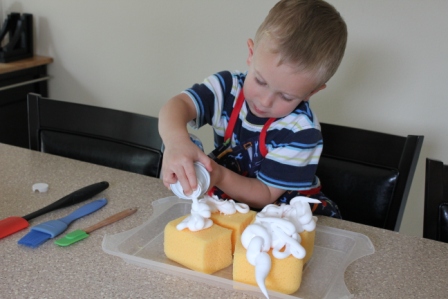
A former co-worker of mine and I did this with some teachers in a series of training's we were doing on a curriculum that emphasizes the importance of play. To bring our point across to them we had them experience a variety of activities themselves, this particular one was a big hit! All you need is a tray, pan, or cookie sheet, several different scraping or spreading utensils, a large sponge, and shaving cream!
You'll notice I cut the sponge. We talked about how things can be divided up into pieces, like pizza, pie, and cake! I told him that he had a whole sponge to frost, but that when I cut it he now had two halves, and when I cut it again he had four quarters. A little math vocabulary for the day.
He proceeded to spread and frost each sponge separately and together.
He decided he needed more shaving cream to get the job done properly.
Then hands seemed to get the job done better.
Who can resist the feel of shaving cream squeeze between their fingers? I joined in on the fun at this point!
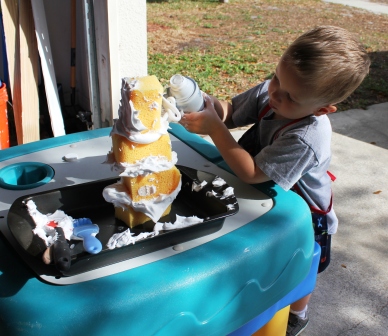
We took the shaving cream outside on another day where he tried out a different approach.
He started spreading each piece with the shaving cream, then stacked them....
and he discovered layering!
I love these paint scrapers that you can find here, as a great alternative for spreading, scraping, and frosting with shaving cream too!
I read a post written by Deborah Stewart over at teach preschool on food use in the classroom recently. Using food for play has been a controversial topic for quite some time, but I felt compelled to share her views because I agree with them, and she said it so darn well. She also references Lisa Murphy, otherwise known as the Ooey Gooey Lady, in the article, that wrote a great piece with some additional points on the topic as well.
The part that stuck with me the most in her article is the fact that our senses are so important in how we learn and retain something. I too remember making patterns with fruit loops as a preschooler! The rough feel of the cereal, the fruity smell as I strung them along soft string to hang around my neck, and the crunch I heard between my teeth when I ate them. I still remember an experiment from 3rd grade that involved food. In fact, it was vegetables, fruits, and cereals, which helped me remember what carbohydrates, vitamins, and minerals are. I instantly get sucked back in time to my mothers kitchen whenever I make homemade chocolate chip cookies. I remember how the flour felt, the importance in the way you measure it, the sound of the wooden spoon scraping the bowl to make sure the ingredients were stirred together correctly, the sweet smell of the dough when the sugary egg part met with the floured ingredients, and the warm gooey taste of the cookie when it came out of the oven after being cooked to an exact time.
One "aha" moment I had in a training I attended a couple years back, and then used to share with others in my own training's, was how closely our sense of smell and the part of our brains responsible for memory work together. My personal examples above show how memories are tagged with senses. The reason we are able to remember certain things over others has a lot to do with how many of our senses were involved at the time. The more of your senses involved, the more places in your brain that memory is stored, which makes it that much easier to pull it out later when you need it because you've stored it in four or maybe five places.
How many senses are involved in the things you do with your child(ren)? Make a goal of involving at least three of the five senses. Talk about and describe them as you play; "See how bright the blue is in our play dough? How does it feel in your hands? Soft, warm, squishy? The dough smells salty, how does it smell to you?"
Have you ever heard of the phrase exercise your writing fingers? If you haven't it's another way of talking about fine motor skills as well as a fun phrase children can understand. My four year old, Aidan, has become very frustrated with writing recently. Before, he happily copied down letters he saw around him or asked for help signing his name on a card to grandma if he couldn't remember a letter. Now, he gets upset and gives up because his letters don't look EXACTLY like the ones he sees around him; whether they are on a box, in a magazine, or in my own handwriting. I do my best to make using letters in his play fun, engaging, and "risk free" (that it's okay to make mistakes and perfection is not the goal) because we've just begun on this long journey of symbols and he's frustrated already. Letters and writing are confusing. Think about how p, d, and b, must look to a child!
My encouraging words have not been making him feel better, "I see you wrote the letter D...I can see all the letters in your name!" I even pulled out a couple of old papers my mother had saved from when I was about his age to show him that my writing used to look the same and I explain that I've been practicing my writing for a very, very long time. I know his concept of "a very long time" can not grasp the years and years I was in school, which was highlighted when he replied "I already have lots of practice!"
Where did this anxiety come from? My husband's simple reply was "He's frustrated because he wants to know how to make his writing look like ours. What else are you doing to show him how?" This is when I realized we had not been playing with enough alternative fine motor fun to exercise his writing fingers lately. Finding other fun ways to write and play strengthens those little muscles, which in turn helps a child grasp a writing utensil better and have more control.
Now if you are a fan of Pinterest, as am I, you can find oodles of ideas to accomplish this. I want to share my favorites, some of which are "oldies but goodies", some I've learned in training, and others I've found on the Internet in various places. These are mostly geared toward older preschoolers:
Ghostwriting: simply write letters or words your child is interested in with a large marker (fat highlighters work best), then have your child trace over what you wrote with a skinny marker, crayon or pencil. Scented markers make it more sensory and interesting as well. (By the way, Aidan really took to the ghostwriting, I was surprised, he asked for twelve different words!)
Taking an old small appliance apart such as a toaster. Supervise, use proper safety gear, and remove any dangerous parts prior to child use! Then children can use screwdrivers and wrenches to work on taking apart something they are curious to see inside of.
Using tweezers to sort small objects on a tray or light box (great homemade version over at teach preschool). My favorite object: alphabet pasta on a tray lined with black paper. Send a child on a "T" hunt! (If you live in the south Publix carries this pasta.)
Clothespins - to a child they are irresistible. They can use colored ones to attach to the edge of a tray to make patterns or match upper and lower case letters to a piece of paper.
Stringing beads
Painting with skinny brushes, q-tips, feathers, or other small objects
Drawing, writing or painting activities on a vertical vs. a horizontal surface. I liked counting around the house over at no time for flash cards and identified with one point she made in her post... "I wish I had a magic wand for my son to make him believe in his ability to write, to know that he doesn’t have to be perfect and to understand that just because reading is easy doesn’t mean that writing should be or that there is anything wrong because it’s hard."
Using eye droppers to mix containers of colored water
Geoboards: I like homemade versions that use pegboards, nuts, and bolts from the hardware store. A variety of materials such as ribbon, rubber bands, string, and pipe cleaners will have a child using that pincher grasp and making shapes in no time!
Using the paper hole punch, add a couple that punch different shapes to keep it interesting!
Many of the activities listed above also promote additional benefits as well, pre-literacy and math skills, science exploration, and cognitive thinking.
Oh the possibilities! Where do I begin? What a blank piece of paper can do for the imagination is much more valuable than what the average coloring book can offer. I have never bought a coloring book for my son because I chose a long time ago to go the route of blank pads of drawing paper. We do have coloring books, he's been given them as gifts from other family members and he does use them once in a while. However, more creativity is demonstrated through the use of blank pages, while providing similar lessons in fine motor skill development.
Blank paper has no boundaries guarded by the already drawn cartoon hands of the most popular new character. It accommodates for the movement of a toddlers whole arm scribbles to an older preschoolers wrist and finger writings. It creates an opportunity for more conversation and new vocabulary!
Don't get me wrong I don't hate coloring books, children enjoy the pictures, they can help with fine motor control ("Stay inside the lines"), and I've seen many examples of adding creativity to a coloring page than those black lines allow. If you've ever worked with young children, or hoarded piles of your own child's work, you've probably noticed the tremendous differences between the coloring page and the blank page...
Drawings on blank paper are more intricate, dramatic, elaborate, sometimes with letters or emerging letter like forms. Coloring pages tend to have their sections colored in...and that's about it.
Drawings on blank paper are accompanied with a story or explanation, whether we can tell what it is or not. It is important to ask, "tell me about your picture," instead of assuming what it is. Coloring pages tend to be limited to telling someone who or what thing they made more colorful.
Blank paper, or other blank surfaces, get more variety from utensils. Whether its a paint brush, roller, crayon, fingers and ink, marker, pencil, pen, glue, or colored paper, we see and use these choices much more with children on blank paper than a coloring page, which usually only gets use from crayons, markers, and maybe some watercolors.
The evidence in the progression of a child's fine motor and creative thinking skills is more visible with blank paper. The start of a simple circle, to faces, the addition of limbs, additional objects like flowers and other scenery. A coloring page will simply show they are coloring outside the lines less and less.
How many original works of art are saved in your home or displayed in the classroom vs. a coloring book page? Have you "gotten the picture" yet?
Because a blank surface offers so much opportunity for those creative little hands, making it available all day to a child is equally important. I keep my son Aidan's supplies in an area where he can access it himself for when the mood strikes, as well as having it sit out as an option everyday at the table in an inviting way. I switch out and offer a variety of utensils and surfaces to keep it interesting, which also strengthens his fine motor skills, including exercising those writing fingers, in different ways.
The Magna Doodle is a great blank alternative surface. Here he explained that this was me on a really long skateboard in the grass outside under the sun (I have never set foot on a skateboard)!
This was done waiting for our dinner at a local restaurant. The sun is shining in the sky over a house that has bad water going out the pipes underneath and there is a pipe coming from the sun putting clean water into the house.
An elaborate spaceship with letters cutout and taped to it.
We keep a dry erase board on the fridge at his height as another alternative drawing/writing tool. This was a drawing of a blender. He explained what each little shape inside was; ice, strawberries, and yogurt (we make a lot of smoothies in our house).
As you can see Aidan does use his coloring books but the results are not quite as exciting. You'll notice concentrated areas colored in on each page. I remember watching him do these then suddenly racing the marker across the whole picture as if to finish it in a hurry? Maybe out of frustration for some reason? I'm not sure but he does spend more time with a blank surface!
CHALLENGE: Give your child a coloring page to work on, then turn it over and watch what else happens!
Finally, I just had to add in the video below to end this post, a song by the Barenaked Ladies titled Drawing. It speaks for itself :)
It seems like the topic of kids and "danger" (I use quotations on purpose because danger is a subjective topic) has risen to the surface of popular discussion on the Internet lately, or I've just run across it often enough to notice. Many adults fear things children do that others would laugh at or think is no big deal. From using scissors, to climbing trees, to using real tools, playing outside unsupervised, helping cook near a hot stove or grill, and even playing with sticks. An adults perspective on potential dangers changes when they become a parent or have been entrusted with the care of another's child, the intensity just varies from person to person.
As for me I believe kids need to be exposed to a little "danger." My husband and I let our son play outside for as long as he likes with the other neighborhood children on the weekend with no adult supervision. Some would be horrified by hearing this but there was much preparation and trust that went into it.
We live on a pretty quiet street with little car traffic.
The other children are older than him ranging in age from five to eleven.
We talked with him several times, set up rules and expectations before this started, where his boundaries are, asking or checking in with us before he does something else (there is a pond a few houses down the kids like to walk around and throw rocks into).
We've set up an area in the garage where he can access his toys. Items not for children are secured elsewhere; an area that is discussed about with him as well.
We do still check on him from time to time, we have not completely lost our minds or our common sense.
Our son has broken the rules twice and we have not had any issues since, but we expected this to happen because children do get caught up in the moment and forget, or test out the boundaries to see how firm they are. Why do we even let him do this? We want him to know that we trust and respect his capabilities by giving him this kind of freedom. It builds his confidence, his independence, and even more importantly his social skills. I have overheard many conversations among the children where negotiating, compromising, and problem solving have taken place instead of one of the children running to me to try and solve the problem. Those skills are tremendously important and used in our everyday adult lives!
Trusting and respecting a child's capabilities can be applied to using scissors, helping near the hot stove, climbing trees, or any "danger," but setting up expectations before you begin and giving a child the chance to try are key. One of my favorite quotes, which I feel fits right into this topic is "If you don't prepare you repair." Otherwise you will never know, as well as the child, how much they can learn and the respect they can have for something, because before you know it they will be able to handle it on their own, or they will struggle when you expect them to do it as they get older.
For some there will be more tries and chances than others, children learn the limits of their own bodies through trial and error and build critical thinking skills as they learn how to do something safely. Different levels of supervision will be involved and children at this age still need reminders. Yes we really are "broken records" as some of our own mothers used to tell us. I want to share with you some powerful words I ran across from another blogger on her Facebook page Let the children play.
If you don't trust your children they will invent their own dangers, because who doesn't enjoy a good thrill? Don't you remember pretending to be a damsel in distress as you clung to the monkey bars ready to fall? Or a daredevil that jumps over mountains, and off the bed? An imagination will take a child to those tempting things in life that have been deemed "dangerous." Our own son has declared parking lots, mulch beds and certain grassy areas as pits of lava and gator filled waters that you must tread carefully around!
A favorite toy can be spotted when it gets played with everyday for hours on end, worn down and beaten up from repeated use. For my son Aidan that toy is the car, a popular choice besides the typical block and stick play we tend to see boys choose. He brings them all over the house with him and they are usually the toy of choice to bring along when we leave the house for appointments and errands.
Taking advantage of a favorite toy when expanding on something a child is learning is a great way to follow their lead or interests during play. Aidan was in his room digging through his large assorted box of cars, trucks, planes, and motorcycles and asked if I wanted to drive and park cars with him. As we sat on the floor dividing up cars between the two of us and placing them in certain areas he had designated he suddenly exclaimed that he made a letter with the cars. I noticed a shape that took the form of a letter A and told him what I saw. Quickly I grabbed a dry erase board and drew a different letter. He recognized the letter O and I showed him how I could park cars on the letter. We proceeded to park cars on a few other letters I drew, then I changed it up a little and tossed out some magnet letters. We parked cars by the first letter in their name, such as T for the tractor. This was even more exciting to him because he was able to attach a letter to something that was familiar to him, like he does every time he sees the letter A, because it is the first letter in his name. Combining things that are familiar and valuable to children when introducing letters, numbers, or shapes keeps them engaged and interested, but these things can naturally happen on their own too. Aidan suddenly needed a couple drivers and pulled out two action figures. He laid them down next to two different cars with similar colors on them while telling me that "the blue car belongs to batman because he is blue, and the red truck is for spider man because he has red on him." Typically, sorting objects by color is the very first thing a child does when organizing their world, afterward size and shape come along, an important form of early math that many don't recognize when they see their child doing it!
We engage in this type of play everyday. I'm not saying all we do is play with cars and focus on letters; I try to follow his lead, noticing what he seems interested in that day. Then "magically," he soaks up other knowledge in a fun way that he will eventually recognize on his own.
One more thing, that moment of car play wasn't just about sneaking in a little letter recognition but also a memory I hope he looks back on and thinks, "My mom loved spending time doing things I loved with me."